
If your week looks like back-to-back meetings, a commute that eats your evenings, and a fridge full of good intentions gone bad — you’re not alone. Meal prep for busy professionals isn’t about turning your kitchen into a production line every night. Done right, it’s a single, focused block of time on the weekend that buys you five days of good decisions, without asking you to give up an entire Sunday to do it.
Most people quit meal prep within two weeks — not because it doesn’t work, but because they start with a system built for someone with unlimited free time. This guide breaks down a realistic meal prep system for busy professionals: one that fits into two hours, uses just three rotating meals, and leans on the right containers to actually stay fresh until Friday.
Why Meal Prep for Busy Professionals Actually Works
The problem isn’t a lack of willpower. It’s decision fatigue. By 7 PM on a workday, you’ve already made hundreds of small choices — what to reply to first, which meeting to prep for, whether that email can wait. “What should I eat” is the one decision your brain has the least energy left for, and that’s exactly when takeout apps win.
This is precisely why meal prep for busy professionals works better than willpower ever will — it removes the decision entirely, before the tired version of you even has to make it. According to Harvard’s Nutrition Source, a balanced meal built around vegetables, whole grains, and lean protein doesn’t need to be complicated — it just needs to be ready.
There’s also a real cost angle. Even a modest daily takeout habit adds up to thousands of rupees a month, and it’s rarely the healthier option. A couple of hours of prep converts that daily spend into a handful of grocery runs — a shift most people notice on their bank statement before they notice it on their plate.
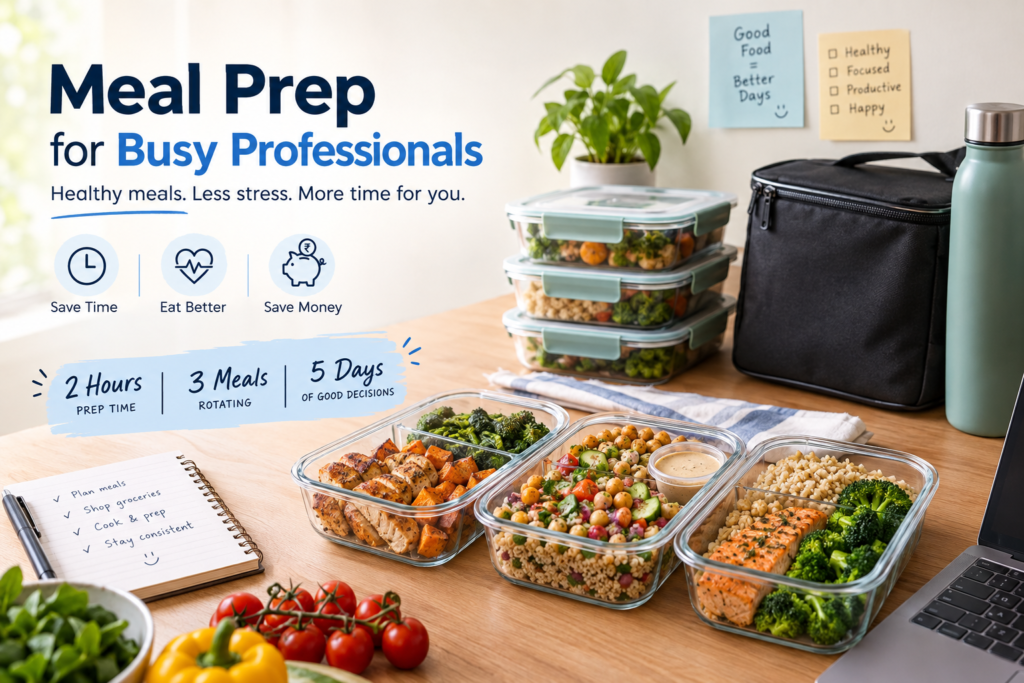
How to Meal Prep for Busy Professionals in Under 2 Hours
Step 1: Plan Three Meals, Not Seven
Trying to plan every single meal for the week is where most people quit by Tuesday. Pick 3 core recipes — one protein + carb + veg combination each — and rotate them across the week. Variety comes from sauces, spices, and sides, not from cooking three completely different dinners from scratch every day.
Step 2: Shop With a Locked List
Once your 3 meals are picked, build one grocery list and stick to it — no wandering the aisles deciding as you go. A locked list also keeps costs predictable. Budget-conscious readers can lean on our guide to meal prepping on a budget for ingredient swaps that cut cost without cutting nutrition.
Step 3: Batch Cook in Parallel, Not in Sequence
Roast a tray of vegetables while a pot of grains simmers and a protein sears — everything finishes around the same time instead of you standing at the stove for three hours, one dish at a time. This single habit is what gets total prep time under 2 hours, and it’s the difference between a Sunday afternoon project and a Sunday morning task you barely notice.
Step 4: Portion Into the Right Containers
This step is where most homemade meal prep fails — not the cooking, the storage. Fit & Fresh’s portion-control containers are built with separate compartments, so sauces and grains don’t turn soggy by Wednesday, and the leak-proof seals mean your bag survives the commute even if it gets knocked around. If you eat mostly at your desk, a grab-and-go container set with a slim profile is worth the small upgrade over generic containers that don’t stack well in an office fridge.
Step 5: Store and Label Safely
Cool food to room temperature quickly (within two hours) before sealing it, then refrigerate right away. Per the USDA’s food safety guidelines, prepped meals are safest eaten within 3–4 days — plan your batch size around that window rather than cooking a full seven days at once. Labeling each container with the date takes ten seconds and removes any guesswork later in the week.
A Sample 3-Meal Rotation for the Week
Here’s what a realistic week looks like once your meal prep for busy professionals routine is running:
- Meal A (Mon/Thu): Grilled chicken, roasted sweet potato, sautéed greens
- Meal B (Tue/Fri): Chickpea and quinoa bowl with a lemon-tahini dressing
- Meal C (Wed): Baked salmon, brown rice, steamed broccoli
Two proteins repeat across the week, but different sauces and spice blends (a chili-lime rub one day, a herb marinade the next) keep it from feeling repetitive. This is the rotation model that makes 2-hour prep realistic — you’re cooking three things well, not seven things adequately.
3 Fit & Fresh Products That Make This Easier
- Divided portion-control containers — keep components separate so textures hold up until lunch on day four, instead of turning into one soggy mix.
- Insulated lunch bags with ice packs — hold food safely in the “danger zone” temperature range during a commute or a long meeting that runs past lunchtime.
- Stackable fridge organizers — turn a chaotic fridge shelf into a week’s worth of visible, grab-ready meals, so nothing gets pushed to the back and forgotten.
Common Mistakes When Doing Meal Prep for Busy Professionals
- Prepping too much variety. Three rotating meals beat seven unique ones you’ll abandon by Thursday out of sheer decision fatigue.
- Skipping the cooling step. Sealing hot food traps steam inside the container, which speeds up spoilage and leaves everything soggy.
- Using the wrong containers. Thin, non-compartmentalized containers turn everything into a mushy one-note meal by day three — see our beginner’s guide to meal prep if you’re just starting out and want a slower on-ramp.
- No backup plan. Keep one freezer meal on hand for the week your Sunday prep session doesn’t happen — because eventually, one won’t.
- Over-seasoning everything the same way. Using the same one or two spices across all three meals is often what makes prepped food feel boring by Thursday, not the food itself.
FAQs
How long does meal prep last in the fridge?
Most cooked meals stay safe for 3–4 days refrigerated, or 3–4 months frozen, per USDA guidance. Build your weekly batch size around that window rather than assuming a full seven days is safe.
How many meals should I meal prep at once?
Start with 3–4 lunches or dinners rather than a full week. It’s easier to gauge portion sizes and flavor fatigue this way, and you can always prep a second small batch mid-week if the first one runs out.
What containers are best for meal prep?
Divided, leak-proof containers that are microwave- and dishwasher-safe hold up best for daily office use — look for BPA-free materials and a snug-fitting lid so sauces don’t leak in transit.
Can I meal prep if I only have 30 minutes on a weeknight?
Yes — pick one component to prep ahead (a batch of grains or roasted vegetables) rather than a full meal. Partial prep still removes most of the weeknight decision-making, even without a full 2-hour session, and it’s a solid stepping stone toward full meal prep for busy professionals habits.
Meal prep for busy professionals doesn’t need a free Sunday or a Pinterest-perfect fridge. Three rotating meals, one focused shopping trip, parallel cooking, and the right containers is the whole system — and it’s realistic to keep up every single week, even during your busiest stretches at work. Start small this weekend, and build from there.